Have you ever caught yourself scrolling without even knowing why?
Maybe you picked up your phone to check the weather…, and twenty minutes later you're watching videos you never intended to watch.
Or perhaps you've said one of these things before:
"I'll just check one thing."
"Where did the last hour go?"
"I really should spend less time on my phone."
"I can't seem to focus like I used to."
"I wanted to read, but I ended up scrolling instead."
If that sounds familiar, you're not alone.
Your smartphone isn't the enemy.
Let's be clear: smartphones are not evil. In fact, they have transformed our lives for the better.
Smartphones help us stay connected with family and friends, learn new skills, navigate unfamiliar places, discover inspiring ideas, organise our lives and even improve our health. Social media can educate us, entertain us and introduce us to people and perspectives we might never have encountered otherwise.
So, the goal isn't to use your phone less. It is to make sure you're choosing when to use it, instead of your habits choosing for you.
When scrolling quietly takes over
For many people, scrolling isn't really about social media anymore.
It's what happens while waiting for the train. On the loo. While standing in a queue. During TV commercials. In bed before going to sleep. At the breakfast table. When waiting for your friend(s) to arrive in the bar. And even during conversations!
Often without consciously deciding to do it.
Why does it matter?
Research suggests that problematic smartphone use is associated with:
poorer sleep
reduced concentration
increased stress
lower productivity
less face-to-face interaction
reduced wellbeing
Not because smartphones are inherently bad, but because small interruptions repeated hundreds of times each week can gradually affect how we spend our time, where we direct our attention and what we experience in everyday life.
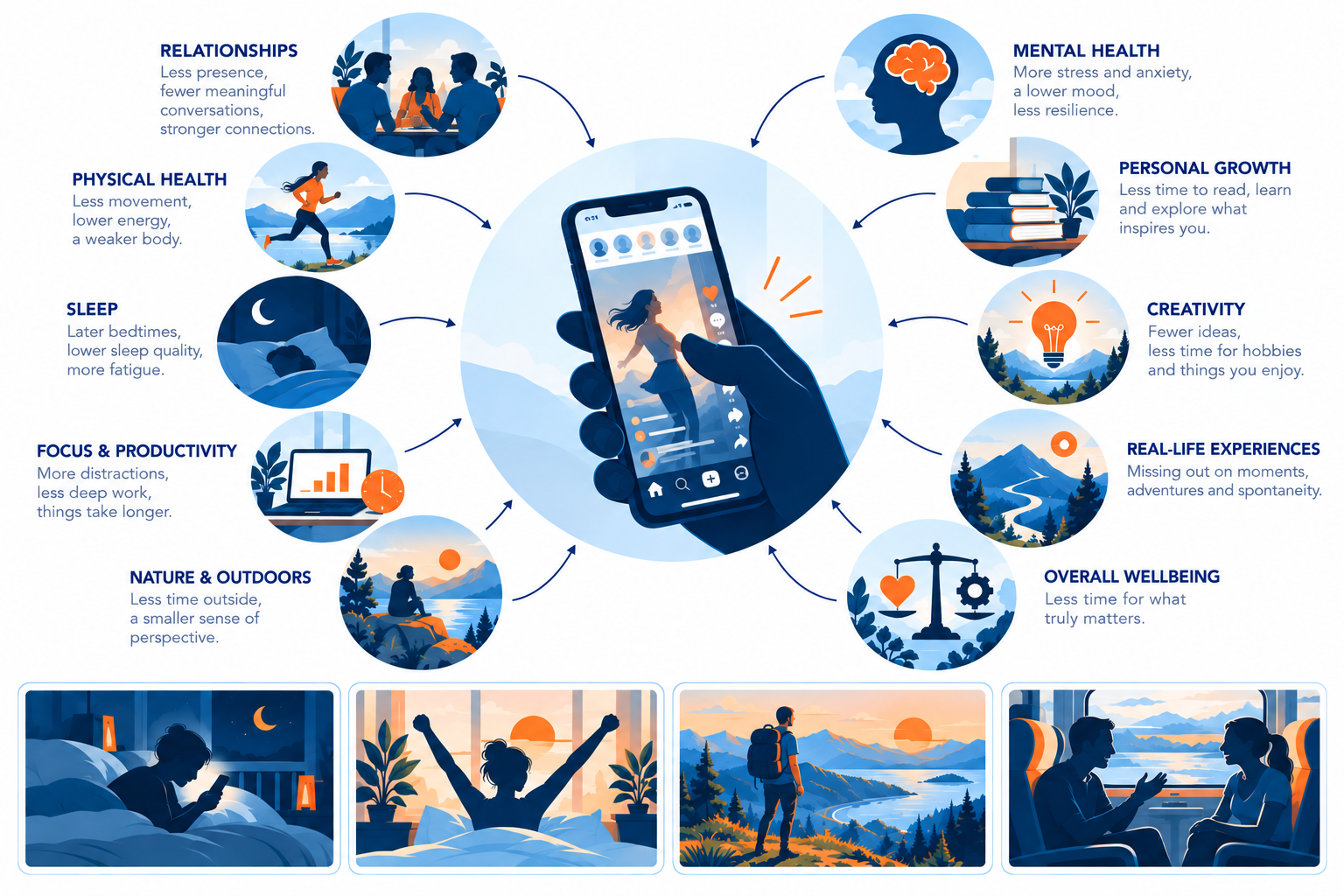
Imagine if those moments looked different...
Imagine finishing that book that's been sitting on your bedside table for months. Having dinner without reaching for your phone. Looking out of the train window instead of into another endless feed. Starting conversations with strangers sitting next to you. Being more present with your partner, children or friends. Taking a walk without documenting it. Simply allowing your mind to wander for a few minutes.
The goal isn't perfection, it is to create more space for the things that matter most to you.
You've probably already tried...
If you're here, there's a good chance you've already experimented with things like:
deleting apps
turning off notifications
Screen Time or Digital Wellbeing
app blockers
productivity apps
a digital detox
a "30-day no social media" challenge
Many of these strategies can be helpful. But for many people, the improvement lasts only as long as the challenge itself. Old habits often return. Not because you lack willpower. Because lasting behavioural change is rarely achieved by willpower alone.
Why coaching?
My approach isn't about banning your phone. It isn't about guilt. And it certainly isn't about becoming a monk. Instead, we explore the behaviour behind the habit.
Together we'll look at questions like:
Why do you reach for your phone?
What situations trigger it?
What need are you trying to satisfy?
Which moments matter most to you?
How can you gradually replace automatic behaviour with intentional choices that actually fit your life?
The aim isn't simply to scroll less, it is to spend more of your time and attention on the people, activities and experiences that genuinely add value to your life.
WANTED: 10 pilot participants (free of charge)
I'm currently developing an evidence-informed coaching programme focused on helping people regain control over their digital habits and attention. To test and improve the programme, I'm looking for 10 people who recognise themselves in the situations described above. Participation is free.
In return, I'll ask for honest feedback about your experience so I can further develop the programme. There is no obligation to continue afterwards.
Is this for you?
This pilot may be a good fit if:
✓ You regularly lose more time scrolling than you'd like.
✓ You've tried changing your habits before without lasting success.
✓ You'd like to become more intentional with your time and attention.
✓ You're curious whether coaching could help.
Interested?
If this resonates with you, I'd love to hear from you. Click the button below, leave your details and tell me—in just a few sentences—what made you stop and read this page. I'd be delighted to explore whether this pilot programme could be a good fit for you.